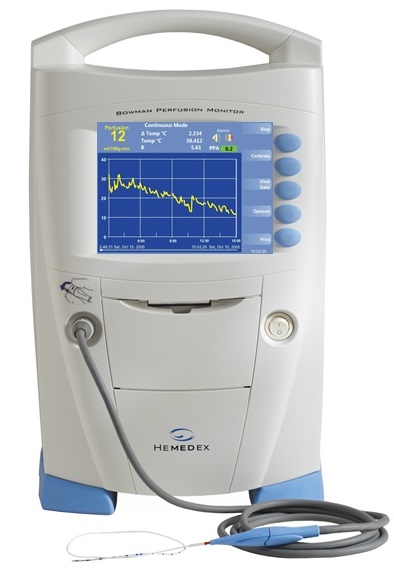
Bowman Perfusion Monitor®
The only monitor that continuously measures tissue perfusion in absolute units at the bedside and in the OR.
FDA Cleared
Learn More

Precision instruments for continuous cerebral perfusion monitoring — from the bedside to the OR
Every component of the Hemedex system is engineered to work together for accurate, continuous cerebral perfusion measurement
The only monitor that continuously measures tissue perfusion in absolute units at the bedside and in the OR.
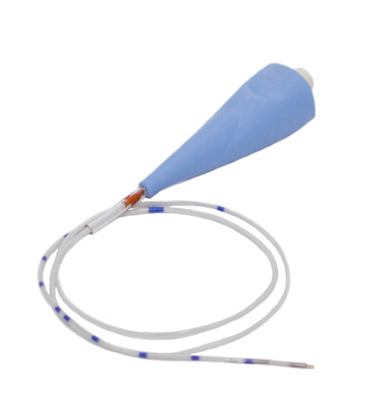
A minimally invasive catheter that quantifies tissue perfusion using the proven thermal diffusion technique.
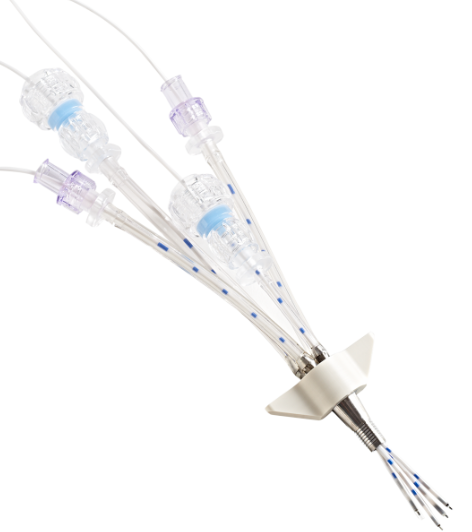
Four-channel bolt enabling full multimodal monitoring — CBF, ICP, PbtO₂, microdialysis, and depth electrodes — through a single burr hole.
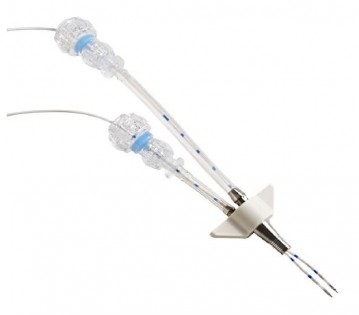
Two-channel configuration supporting any two of CBF, ICP, PbtO₂, microdialysis, and depth electrodes through a single burr hole.
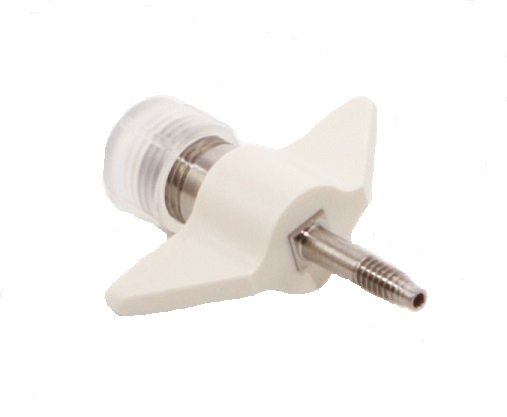
Dedicated fixation for the QFlow 500™ Perfusion Probe when standalone cerebral blood flow monitoring is the primary goal.
In Development
Product imagery coming soon
The Bowman Perfusion Monitor delivers clinically meaningful cerebral perfusion data at the bedside. HMVS builds on that foundation, expanding it into a larger, synchronized visual environment for live viewing and longitudinal review.
Learn More
The Bowman Perfusion Monitor is the world's only device that continuously and quantitatively measures regional cerebral blood flow in absolute physiological units at the bedside or in the operating room. Designed for extended use in the Neuro ICU, it provides clinicians with a real-time perfusion signal that no other bedside monitor can deliver.
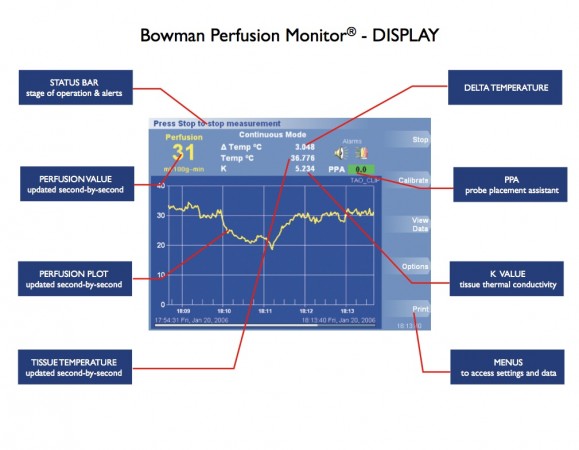
Front display view
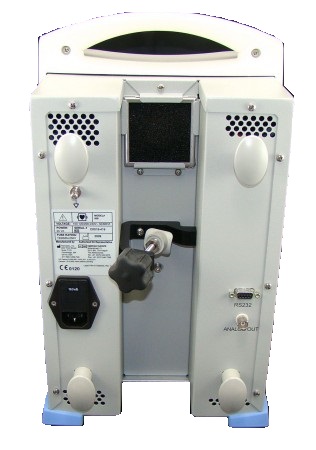
Rear panel connections
The BPM is primarily used in the Neurointensive Care Unit (SAH, TBI, ICH) and the Operating Room (TAO, AVM, Moya-Moya, EC-IC Bypass).
Tissue temperature: In the process of measuring perfusion, the BPM measures tissue temperature as one of the key variables.
Tissue thermal conductivity (K): K is a proxy for regional tissue water content and has been shown to be a useful indicator of brain edema.*
* Ko et al. "Real Time Estimation of Brain Water Content in Comatose Patients." Annals of Neurology DOI: 10.1002/ana.23619 (2012).
The BPM connects with one probe at a time.
The BPM provides both analog and digital outputs which interface with a number of patient monitors and data acquisition systems.
Digital output interfaces:
Analog output interfaces:
Yes, current and prior patient data can be reviewed on the screen. Patient data can also be downloaded for review and analysis — Hemedex provides downloading tools. The BPM can store up to 15 days of patient data. We recommend downloading patient data if your monitoring will extend longer than the available time.
Yes, the alarms are disabled by default. Users can enable alarms and set custom limits.
Through the internal printer, you can print:
No manual calibration or zeroing of the BPM is required. The BPM periodically automatically cycles through the 3 measurement phases to update changing patient tissue thermal properties (Conductivity & Diffusivity), which vary with slowly changing levels of edema.
No, the BPM operates on A/C power (110V or 240V, depending on location).
Standard 1-year warranty included with the purchase of a Bowman Perfusion Monitor® (BPM).
Hemedex, Inc., warranties this product for a period of 1 year from the date of installation (as evidenced by receipt of warranty card by Hemedex) and technical acceptance by the final customer, limited to parts and labor.
A return authorization number must be obtained from Hemedex, Inc., before returning a unit for repair. Warranty-covered repairs will not be performed without a return authorization number. At the option of Hemedex, Inc., a defective unit will be either repaired or replaced.
Extended warranty options and pricing are available upon request. Contact us for details →
Designed for direct parenchymal placement, the QFlow 500™ is a minimally invasive, single-use biocompatible perfusion catheter that houses two precision thermistors. The Bowman Perfusion Monitor's thermal diffusion algorithm calculates continuous, absolute CBF values.
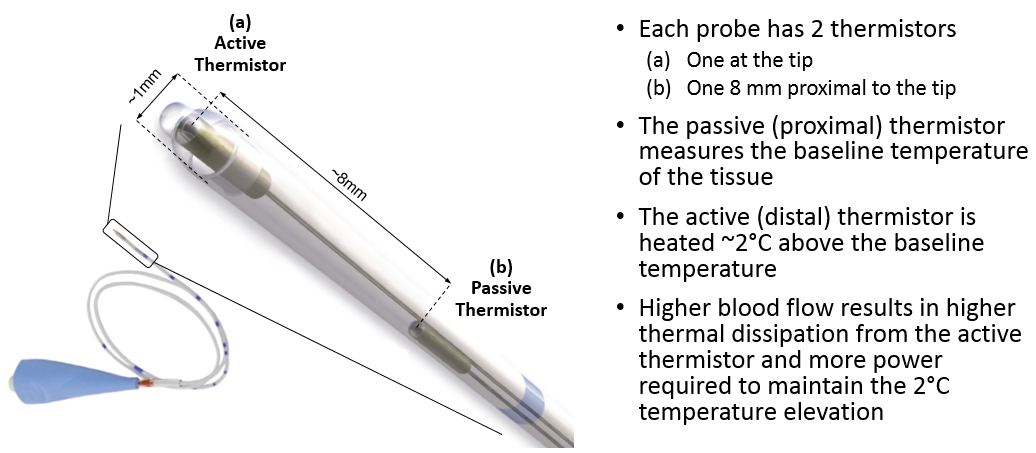
Probe-thermistor detail
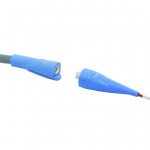
Probe and umbilical cord connection

Probe placement video
Similar to other brain parenchymal probes, the QFlow 500™ Perfusion Probe is inserted through a burr hole and positioned 2.5–3 cm below the dura into white matter. Hemedex recommends using the QFlow 500™ Titanium Bolts. For ease of insertion at the recommended depth, Hemedex recommends the Probe Dura Piercer and Introducer.
The probe should be placed in the vascular territory of interest:
The probe tip should be completely surrounded by tissue.
No, the QFlow 500™ Perfusion Probe is a single patient use item.
The probe is indicated for 10 days of use.
Yes, the probe is CT compatible. The probe is also radio-opaque for imaging verification of placement.
The probe uses a thermal diffusion technique. A heated thermistor warms a small volume of brain tissue, and perfusion carries that heat away. The power required to maintain a fixed thermistor temperature is continuously measured and converted to absolute perfusion values. Learn more about Theory of Operation →
The Universal Quad Lumen Bolt is specifically designed to secure all commonly utilized intraparenchymal sensors, providing four independent lumens through a single burr hole. It supports CBF, ICP, PbtO₂, microdialysis, and depth electrodes.
Multiple peer-reviewed publications confirmed that: ICP, PbtO₂, Temperature, CBF, Conductivity (K), depth electrodes, and microdialysis can all be safely and reliably placed simultaneously via this single-access approach — minimizing procedural risk while maximizing monitoring utility.
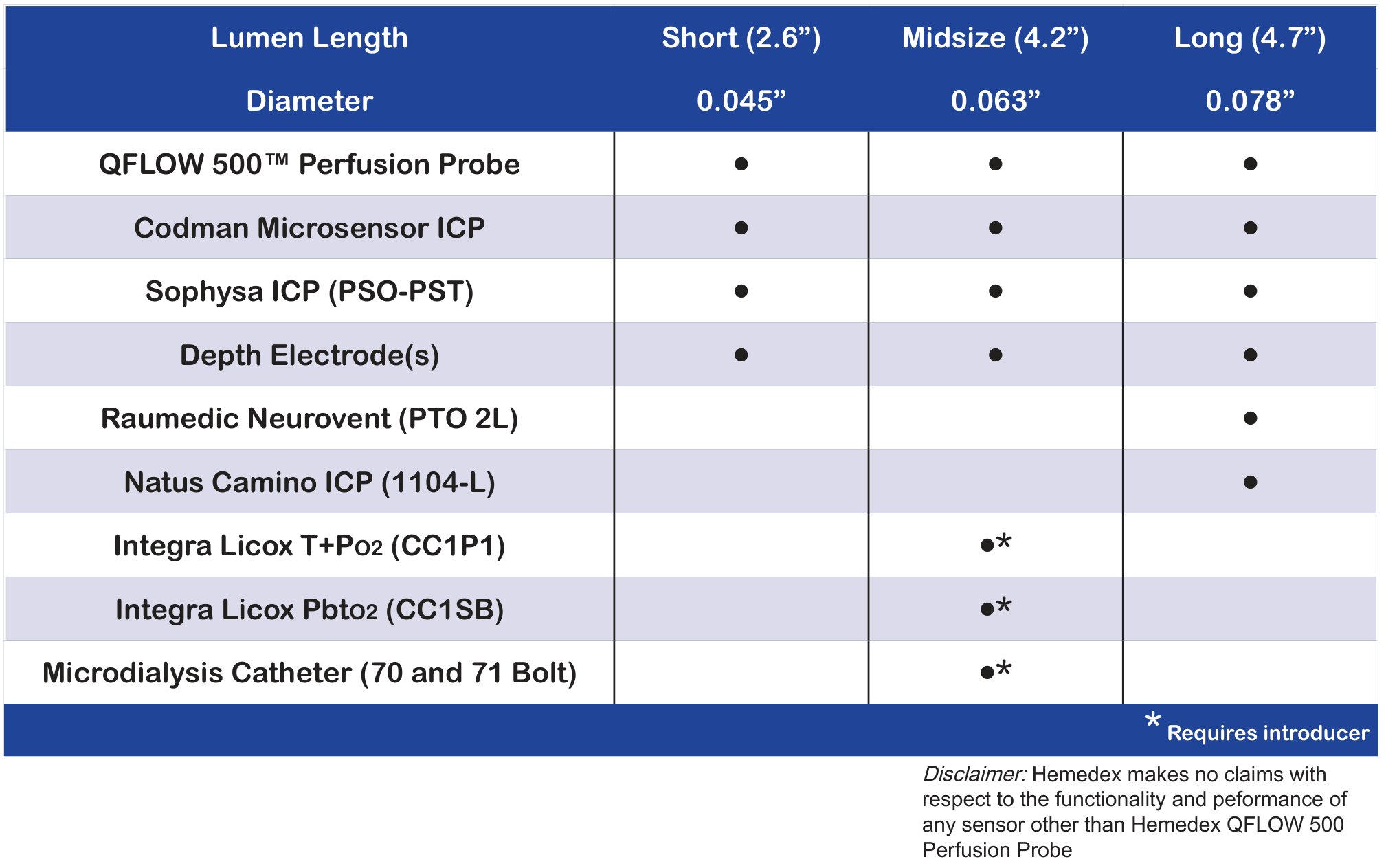
Quad Lumen Bolt: Sensor-Lumen Compatibility Chart
Perfusion Probe Depth Placement in the Quad Lumen Bolt
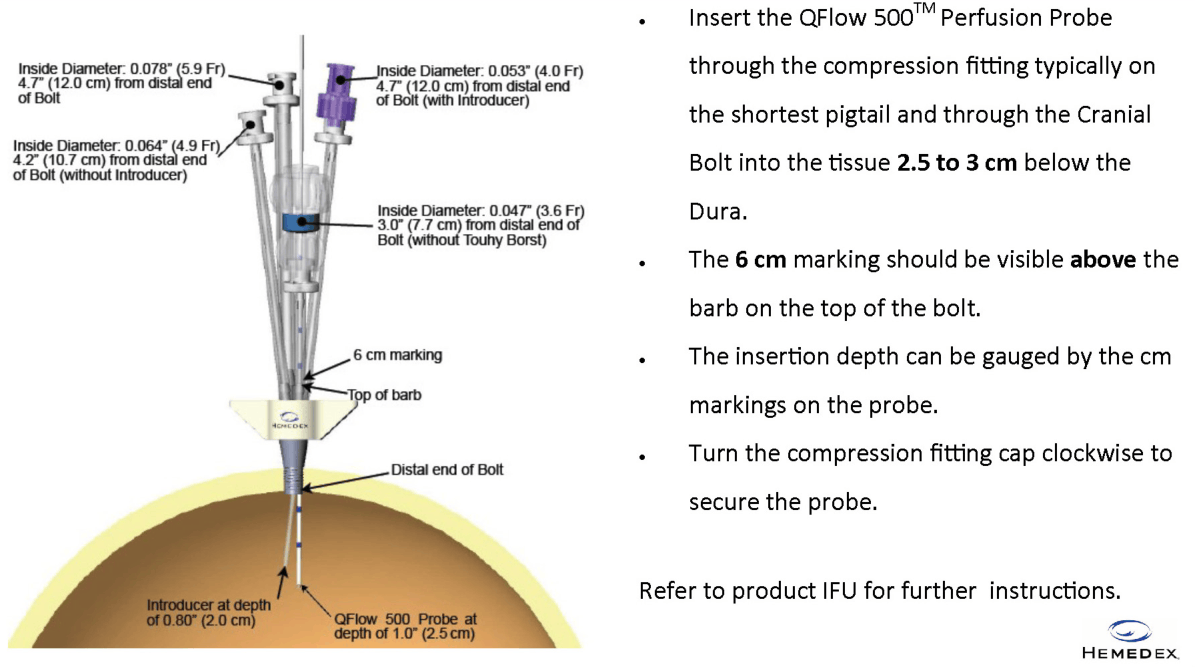
One lumen accommodates devices < 0.078″ in diameter. Two lumens accommodate devices < 0.064″ (without introducer) or < 0.053″ (with introducers). One lumen accommodates devices < 0.047″ in diameter.
Yes, the bolt is CT compatible.
Yes. All 4 Lumens end with a luer lock, and 3 luer lock-compatible compression fittings are included with the kit.
The bolt is indicated for 14 days of use.
No, the bolt is a single-use item for human clinical purposes.
Introducers are used for delicate sensors (i.e. Microdialysis and Licox catheters) that may need help passing through the dura.
Sealing caps permit the neurosurgeon to place the bolt, which subsequently allows the neurointensivist to later place any number of sensors, as indicated for patient management.
Non-clinical testing has demonstrated the Hemedex QFlow 500™ Titanium Bolt Kit is MR Conditional. A patient with this device can be safely scanned in an MR system meeting the following conditions:
Under the scan conditions defined above, the device is expected to produce a maximum temperature rise of less than 0.3°C after 15 minutes of continuous scanning at 1.5T and less than 0.6°C after 15 minutes at 3T.
The image artifact extends approximately 25 mm from the bolt when imaged with a gradient echo pulse sequence and a 3T MRI system.
Note: Prior to transporting to MRI, remove all MR unsafe/conditional sensors. Never leave stylets or MR unsafe sensors in the bolt during MRI. Hemedex recommends lumens be closed/capped following removal of any sensors.
The Dual Lumen Bolt Kit delivers optimal fixation for the QFlow 500™ Perfusion Probe while providing access for one additional parenchymal sensor. This two-channel configuration supports any two of CBF, ICP, PbtO₂, microdialysis, and depth electrodes — ideal for institutions beginning their multimodal monitoring journey or for cases where a focused two-parameter approach is clinically appropriate.
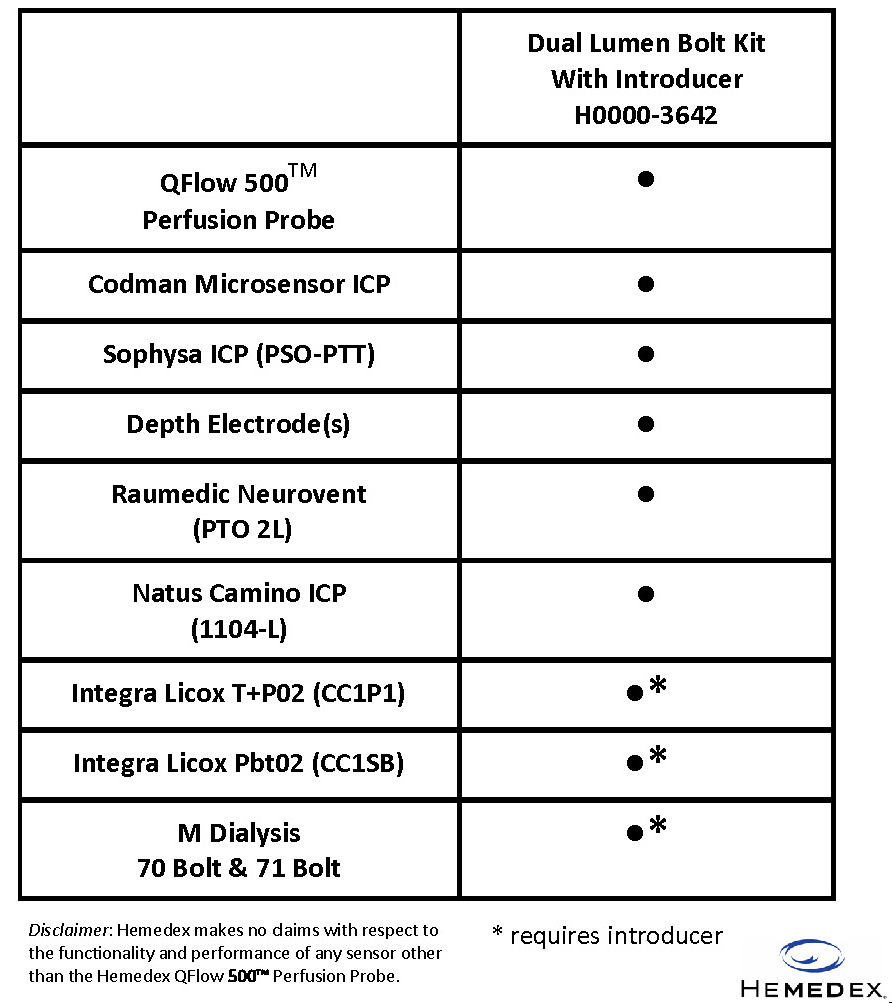
Dual Lumen Bolt: Sensor-Lumen Compatibility Chart
Perfusion Probe Depth Placement in the Dual Lumen Bolt
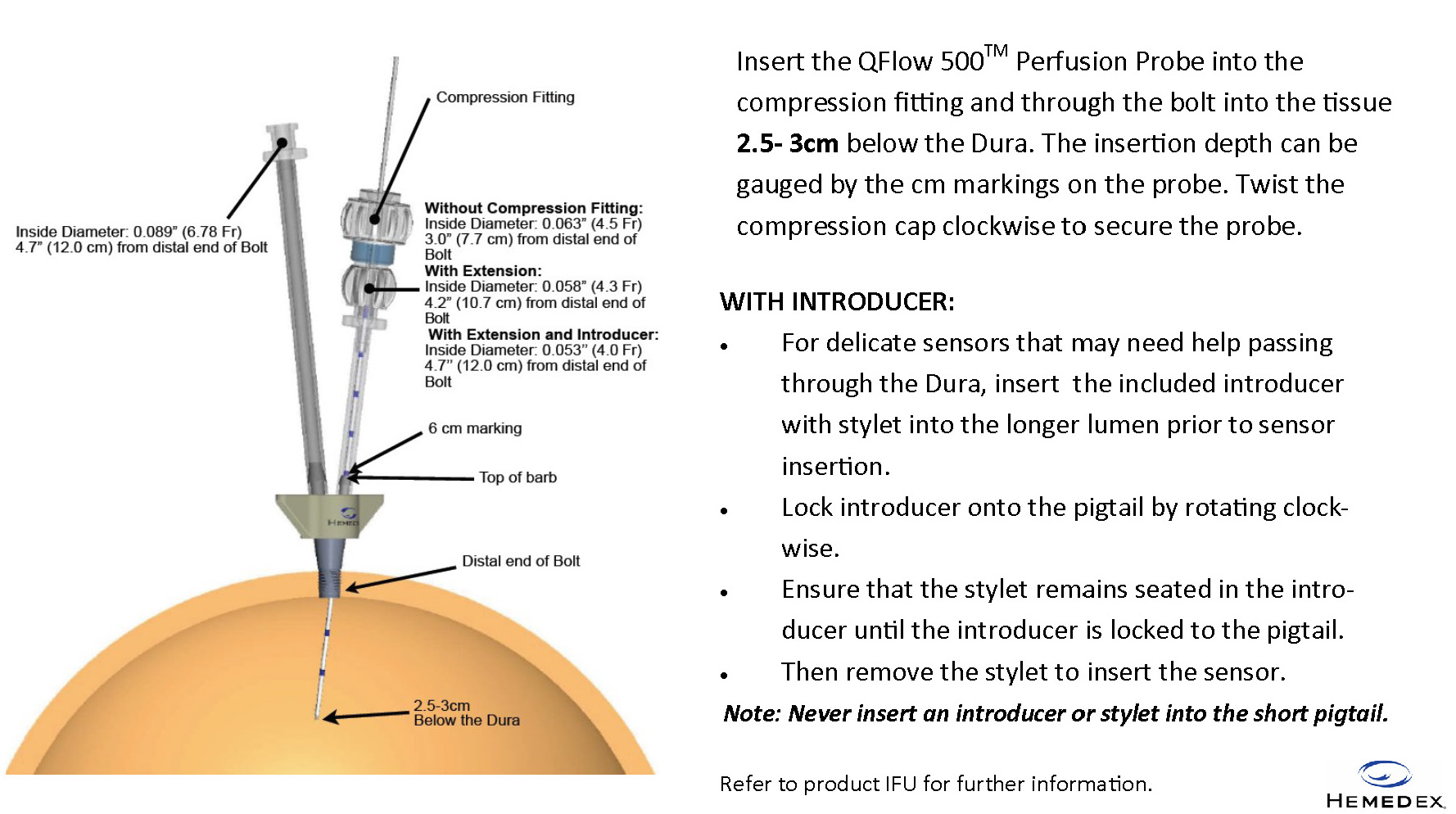
The long lumen accommodates devices < 0.089″ in diameter. The short lumen accommodates devices < 0.053″ in diameter.
Yes, the bolt is CT compatible.
The bolt is indicated for 14 days of use.
The Single Lumen Bolt Kit provides secure, dedicated fixation for the QFlow 500™ Perfusion Probe when standalone cerebral blood flow monitoring is the primary clinical objective.
| Lumen | Max Diameter | Compatible Sensors |
|---|---|---|
| Single Lumen | 0.060″ (1.5 mm) | QFlow 500™ Perfusion Probe, Depth Electrode, Codman Microsensor ICP, Sophysa ICP (PSO-PTT) |
* Hemedex makes no claims with respect to the functionality and performance of any sensor other than the Hemedex QFlow 500™ Perfusion Probe.
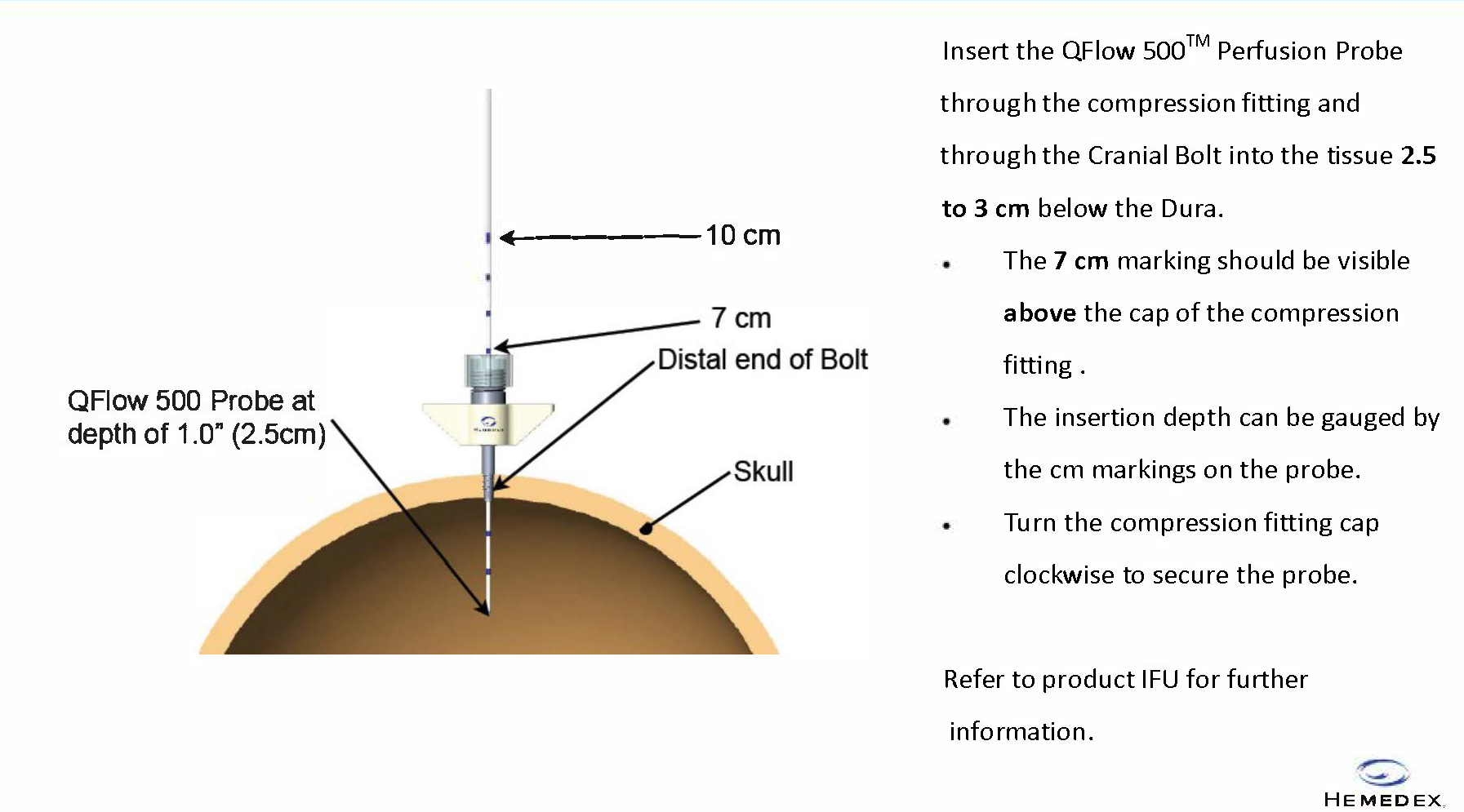
Perfusion Probe Depth Placement in the Single Lumen Bolt
Yes, the bolt is CT compatible.
No, the bolt is a single-use item for human clinical purposes.
Yes. Non-clinical testing has demonstrated MR Conditional status under the following conditions:
Maximum temperature rise: < 0.3°C after 15 min at 1.5T; < 0.6°C after 15 min at 3T. Image artifact extends approximately 25 mm from the bolt.
The Bowman Perfusion Monitor delivers clinically meaningful cerebral perfusion data at the bedside. HMVS builds on that foundation, expanding it into a larger, synchronized visual environment for live viewing and longitudinal review — designed for the modern Neuro ICU and operating room.
In Development
Product imagery coming soon
"We report our experience over a 2-year period using a standardized bedside, single burr hole approach to intracranial multimodality monitoring. We were able to safely and consistently measure ICP, oxygenation, regional cerebral blood flow, temperature, and function. This approach generated real-time neuromonitoring data and provides a benchmark for the future use of MMM to guide a precision-medicine approach to the clinical management of patients with severe acute neurological injuries, such as TBI."
Brandon Foreman et al., "Safety and Reliability of Bedside, Single Burr Hole Technique for Intracranial Multimodality Monitoring in Severe Traumatic Brain Injury," Neurocrit Care, 2018 Dec;29(3):469-480.
doi.org/10.1007/s12028-018-0551-7 →
Talk to our sales team about adding Hemedex technology to your institution's monitoring protocol.
Talk to Sales